

Engraving & Ornamentation Works
Engraving and ornamentation works are done to enhance the aesthetic beauty of buildings. Engraved designs and patterns are made on building materials like brick, tile, stone, pavers or a ranging variety of graphic elements.
For ornamentation of Concrete, Geometric patterns with straight, circular or serpentine lines and custom designs are cut directly into the surface. Decorative concrete engraving adds depth and dimension plus it is commonly used as a color separation technique.
The functional & technical expertise coupled with extensive industry knowledge makes ITSME an ideal choice for its clientele. Our goal is to exceed the expectations of our clientele by offering outstanding services & a greater value.
In Concrete engraving several tools have been designed specifically for or adapted. Intersecting lines and graphic elements are easily controlled with precision tools which have appropriate cutters. Dust control is a necessity while engraving and most tools have shrouds and guards which attach to standard shop vacuums. Pneumatic tools have combination water/vacuum dust control. The bottom of the engraved area is as visually important as the surface, making accurate depth control essential. Engraved kerfs may range from very narrow to very wide, depending on the design parameters. Kerf depths are typically 1/16th, 3/32nds or 1/8th inch deep. Depth of the engraved lines can be purely aesthetic or functional. A deeper engraving is required in order to hold sufficient amounts of an epoxy or grout in the recessed area.
Concrete engraving tools, be it pneumatic or electric, cut the surface with various methods including: abrasive diamond blades, sand blasting, shot blasting, micro-rod impaction and reciprocating stylus. There are tools used in combination with design templates to achieve exacting graphics and artistic results.
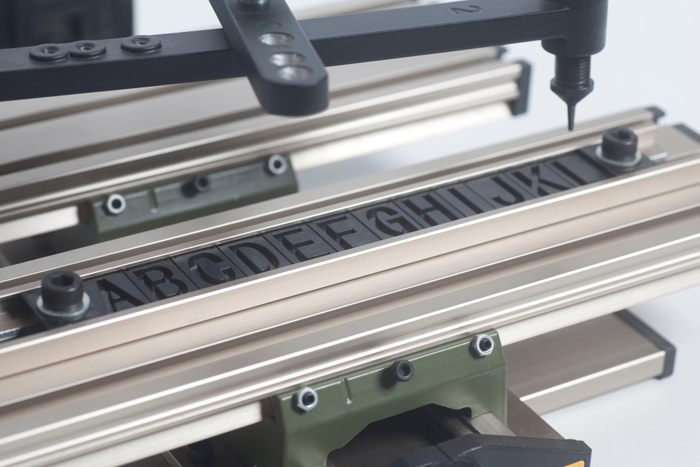
Templates can be made of a variety of materials including single use adhesive backed vinyl or reusable non-marking plastic. Engraving tools can be controlled with tracking systems to make perfect circles, arcs or straight lines or to efficiently produce patterns like brick. Although tile patterned flooring is a common theme, engraving is used to reproduce or enlarge original artistic designs and graphics, restoration or make-over projects for vintage concrete, producing specialty logos, traffic warning symbols or textures, and thousands of patterns. Some patterns are used as decorative safety grooving. Coloring of the cured concrete surface before engraving is typical. Coloring is accomplished by use of a variety of chemical agents, although reactive acid chemical stains, water based, solvated stains and/or concrete dyes are the most common.